Sunday, October 20, 2013

Temporarily Out of Full Retirement

Late afternoon light on Sequim Bay beaches...
I used to joke with my other retired friends that if we ever needed - or wanted - a job, we could go and become greeters at the local Whereyoufindeverything Store... but that really is not something I enjoy, where writing and editing truly is.

Since May I have been caring, on a part-time basis, for an elderly lady who has become a dear friend. Cooking and keeping up with her household affairs was an enjoyable duty and starting a routine for the two of us to have tea at 4 p.m. was something we both came to enjoy. Sadly, several weeks ago her family decided to place her in an assisted living facility. Although I was paid to spend afternoons with her during a transitional time, it is clear that her level of awareness and ability to move around has been degrading daily.

Last cutting for the fall hay season is done.
The joy of conversation and laughter is disappearing as well. She sleeps a lot, is in a tremendous amount of pain from spinal stenosis and arthritis, and her motivation to get up dwindles like the afternoon sunshine in fall. She mused aloud recently, "I wonder when I will get out of this place." What could I say? At 92, with her ailments, she doesn't have the motivation or physical resources to do necessary therapies to maintain muscle tone and strength. The inevitable slide downward is hard to watch.

As we age, it becomes more and more important to stay active, and to drink water that is 'good,' not just  processed. One month of not doing certain physical exercises will have a negative effect. Strength training, walking, and eating fresh foods are essential. I tried to get Mrs. R to walk with me, but every step was painful. I encouraged her to do some weight lifting but she soon tired of the effort. I cooked fresh foods every day, but with less and less activity there was less and less appetite. Clearly everything NOT done was affecting everything else. And when I had to leave for several weeks to close out my affairs in Colombia, I was pretty certain no one else would push her to make some effort. When I returned, I could see that I had been right.
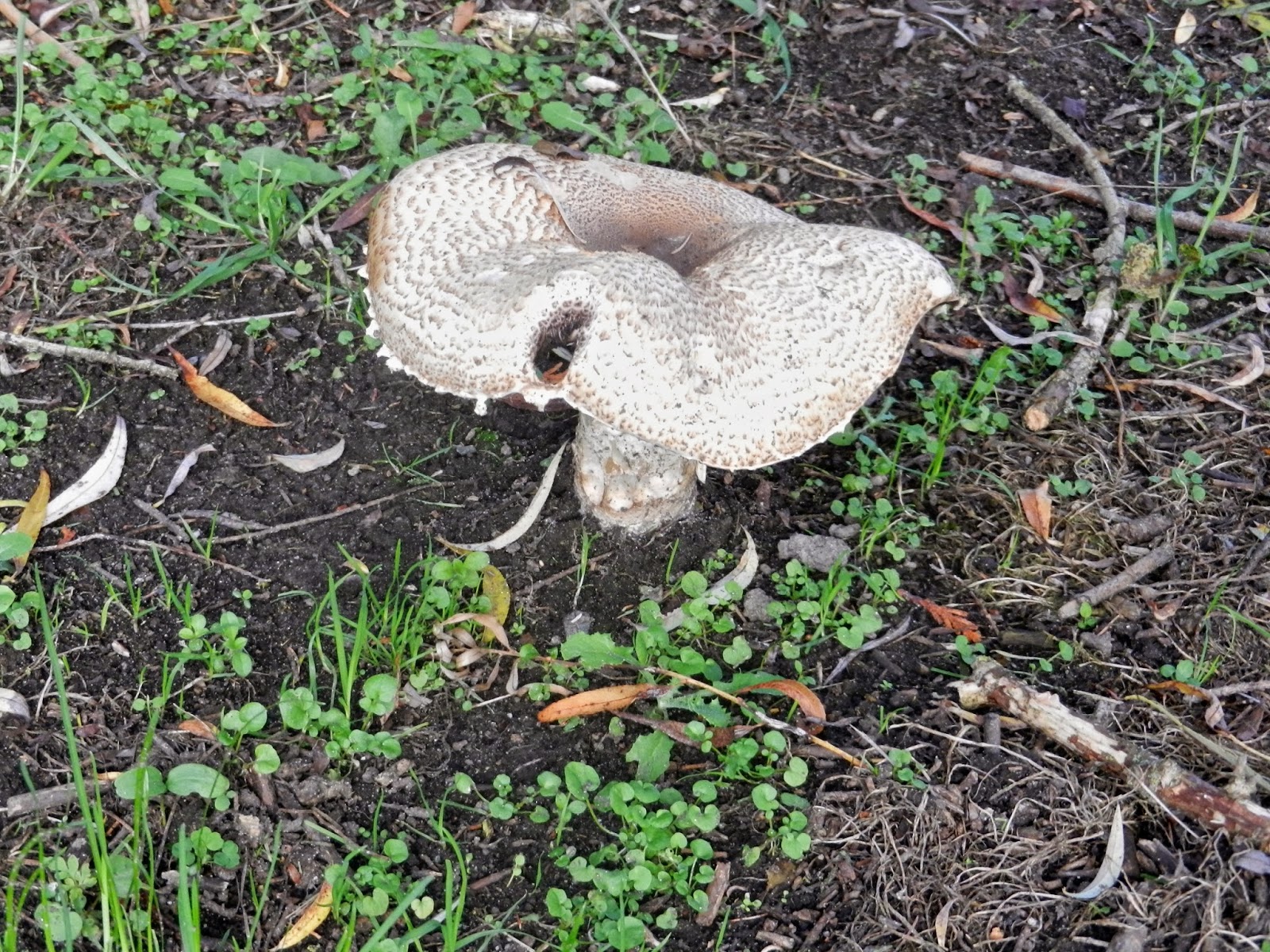
I'm not a mushroom specialist, but the shape of this one
was intriguing. The Elks Lodge had a show this weekend.

Someone piled up stones on Rialto
Beach, like the Tibetans prayer piles.
While this end-of-life process is sad, there is a certain hopefulness in my friend's eyes as she tells me she is looking forward to being reunited with her beloved husband.

And as her cognitive life wanes, she cares less and less about the world around her, resulting in a sort of peaceful place where napping means no pain and no concerns. She awoke from just such a nap the other day and said to me, "It gives me such pleasure to wake up and see you sitting there, being here for me." I am grateful I can do that much for her now.

But I recently learned of a part-time job on a newspaper, and like the aging dalmatian fire dog who is accustomed to jumping up at the ringing of the fire bell, I was drawn to apply.

My part-time job will still allow me to have some time with Mrs. R, but more importantly I will be continuing to keep my own mind active as well as affording time for the gym and weekend journeys. If I have a couple of decades ahead of me, I certainly want them to be healthy ones.

Tuesday, October 15, 2013

Seeing Red...

Afternoon sunshine intensifies the colors along West Sequim Bay Road.
and yellow, and orange and all the subtle colors in-between that remind us that the fall season is well started here in the Northwest. The air is definitely cooler and snow is accumulating on the very tops of the mountains of the Olympic Range. A few mornings ago I could see frost on the rooftops and grass.

It is more and more likely to be in the 40's until the sun has a chance to warm things up and another one of my favorite fruits is being harvested all around the state. Apples!!
This tree, in an orchard near my house, was grafted years
ago and now gives both red and yellow fruits.

I do not know what strain of apples these are, but they are
very dense, crisp and juicy, but not very sweet.
It's a great time to get out and walk in the parks, but sadly many of them are national parks and are closed to the public until the government is operational again.

There is no end to the excitement of living near the Olympics, the wilderness. Sequim is already known for the elk herds that cross Highway 101 near the John Wayne Marina, and I've had several encounters with deer and fawns in this area.

But when we went to the apple orchard near my home, I saw something in the grass that my former life as a Spudette (Idaho citizen) caused me to stop and take a photo.

And, once home, with access to the Internet, I asked the question (Not: does a bear do it in the woods?) but when a bear does it, what does "it" look like? I vaguely recalled the shape from my life in Idaho decades ago, but wasn't sure.

I think this is bear droppings.... or
should I say these ARE droppings?
I'm not sure, but if you are, let's
hear from the experts!


And here is the link for identifying bear poop, also known as "droppings" and sure enough, it looks like what they describe for brown and black bears.

UPDATE: This is indeed the sign of bear(s) and here is a link as to what the Washington State Department of Fish and Game advises people on bear behavior. I will be more careful on my walks, especially in the orchard knowing I am sharing it with a critter.

Some nights I can hear the coyotes howling in the distance, and on Monday nights we put out our trash cans for pickup, but I think now I will wait until Tuesday morning to set mine out so I don't have to deal with the anxiety of either finding it tipped over or hearing it getting knocked over during the night by something a lot larger than the neighbor's dog.

It's surprising enough to find such evidence anywhere, but merely yards from my home is a little niggling reminder that since the wilderness isn't that far away, neither are the creatures that live in it.


Sunday, October 6, 2013

Mt. Rainier Scenic Railroad Trip

A view from the train platform of the charming little 1906
Lutheran church in Elbe. Come early, seating is limited.
The first weekend of October did not find me lazily snoozing under my down blanket. No, I was up bright and early with my lunch packed, my layers of clothing and my camera heaped on my arms, all ready to go on the Shipley Senior Center's trip to the Mt. Rainier Scenic Railroad in Elbe, Washington.

Our group started from the Center just before 8 a.m. because the sunlight, and thus the photo opportunities, fade significantly after mid-day at this time of year. The low-lying fog was burned off by the time we crossed Puget Sound and moved inland.

We had reservations on the 12:45 p.m. trip and we were required to be on the platform by 12:30. The trip from Sequim was estimated to take just under three hours.

Fortunately this trip was not dependent on the U.S. Government being operational, which it still is not at present.
The waitstaff in the restaurant were not happy to be sitting
around with nothing to do since the national park is not
open at present. Some of us decided to eat here to help out.

Although all the national parks are closed because employees have been furloughed by the government's closure, the scenic railroad is a private operation started in 1981 and is run largely by devoted volunteers with some equally committed paid staff.

Our drive took us past Mineral Lake, a milky-grey-green colored body of water. The color is caused by the waters coming down from the Mt. Rainier glacier with bits and pieces called "glacier flour"being moved downstream by the  rivers into the lake.

As we arrived, on the right side of the road are a number of brightly colored cars and a couple of cabooses, which are part of a motel offering sleeping accommodations. Other cars provide an innovative place for pizza as well as a more structured dining option.
I wonder if the sleeping accommodations are improved over
what the railroads might have offered in 1890?
On the left, the post office, a mini store, and the General Store, recreated from the old I.O.O.F. hall, offers fishing tackle, beverages and other essentials.

Just below you can click on the raw video of the train arriving in the station, complete with steam whistles and bells. (Perhaps that is where the expression "all the bells and whistles" came from"...)


Winding through evergreen and deciduous
woods, the train travels slowly past farms
and now-empty fields that once had homes
for the pioneer loggers.
The train leaves from a reconstructed train depot in Elbe, which welcomed the first train for the Tacoma & Eastern Railway in April of 1904.
Looking out from the back of the train.

This town was once a bustling and prosperous lumber center, but is now dependent more on tourism than logs with the 2010 Census showing only 10 households listed for a total of 29 people in the town.

The 40-minute ride to Mineral through the foothills of the majestic sleeping volcano of Mt. Rainier ends with an approximately 45-minute tour of antique logging locomotives in what will one day be a very extensive museum of early railroading.
Old equipment on a spur waiting for a benefactor to restore  it.
The locomotive must be turned around at each end of the line, so I asked if I could get up in the engine area for a photo of the boiler. I was invited up and given some wonderful history of steam engines and a chance to ride up there while they backed up to the cars.
Peeking into the inferno...

The fireman opened the door where, in older coal-fired
engines the stokers would have shoveled in coal.
Although the fall breezes outside were registering about 65 degrees in the sun, the engine area was more like a summer scorcher. I was shown how the water pressure is maintained with the crude oil being burned. Both the engineer and the fireman are volunteers and the engineer said he was inspired by his first trip to go to the University of Washington and get a degree in Forestry.

The engineer works for Weyerhauser for his regular job.
The fireman explained in simple terms how water and oil
are used to create the necessary steam to drive this engine.
There are open cars and cars with windows that open. Seating is not geared for comfort, and since I was hopping up and down to get photos, I don't think I spent much time in my seat. There is an old car with large doors which reminds me of the mail cars of yesteryear where riders can get popcorn, candy, drinks and souvenirs. And two rest rooms.

I imagine the staff would do all they could to make it possible for someone in a wheelchair to be included, but it would definitely be something to call ahead about. I found everyone to be most helpful, although there was a sort of casualness about the train's time schedule, after hearing we had to be on the platform on time.
Watering the train between runs took more time than usual, probably because the volunteers are only to willing to spend a few minutes talking about trains. But if you want to ride up with the engineer and fireman when they are backing up, all you have to do is ask.

During the spring and fall, I would recommend the late morning or early afternoon run because as we were heading back, the lowering sun and cooler breezes made for a cooler return trip. This is very important for children and elderly riders as the cars are not heated.
Mt. Rainier appears to have a fresh suit of snow and the Nesqually River
was running clear on this lovely bright fall day.

As the sun shone down on my face and I listened to the train's whistle as we approached the crossings, I was easily able to recall being about 4 years old, riding with Pat on the narrow gauge train we had in our back yard.
Me, on my first train ride - a long time ago. I think the
photo credit should go to my father,  but finding it for the
blog the credit goes to my younger brother.
The clackety-clack of the steel wheels on the rails beat a staccato melody of memories... riding the Cranberry Express in Carver, Massachusetts on our way to have a vacation on Cape Cod... taking the Long Island Express out to Orient to visit my uncle and aunt... catching the Amtrak from Jacksonville, FL, to visit a friend in Tampa... I still have one ride on my Bucket List: to go through the Canadian Rockies by rail.
Maybe I really am a Hobo at heart...

Wednesday, September 25, 2013

Fallen Leaves

I have loved the fall season, most especially when I lived in Sun Valley, Idaho because it was the 'shoulder season' - a bridge between the summer tourists enjoying everything the Wood River Valley had to offer and the frenetic pace of service for the winter skiers. With more rainy days, now I am spending time researching and writing, my own kind of shoulder season before the holidays.

The nights are also cooler, but not enough for me to get out my down quilt. Just enough for my pal Maksim to meow around 10 p.m. to order me to get into bed so he can snuggle up next to my legs.
Maksim, a large grey adopted cat, always has this look of
surprise, as if he should have a text cloud above his head.

The leaves have begun to turn, some curling up their edges as if burnt by the heat of summer, some proclaiming the advent of another season with brilliant oranges or red and many simply fall to the ground, pale from the lack of chlorophyll and receding sunlight.

My duties as caregiver to an elderly woman have been partially relieved as she has been placed in Assisted Living, though for her it is really much more care than that. We sit in the fading light of the afternoon and talk about when she will 'get out of this place,' and both of us don't discuss how that might happen.

Mrs. R, as I will call her, is widowed and her seasons are like the words in "September Song" where the days whittle down to a precious few as her bones resist any movement. Her son came by and asked if she had her hearing aid on. She and I chuckled privately at this potential for a silly exchange and I marveled once more at her ability to harness her wit to her will, still.  I said to him, "I wonder that she really needs the hearing aids as I have witnessed your mother's ability to almost hear the deer tiptoeing across the golf course." She smiled at the compliment and he pulled himself up and said, "I am still blessed with good hearing as well." (I thought to myself words my grandmother spoke to me: "Hearing is not the same as listening.")
Fall fog set off this ancient truck at the nearby dairy farm.

It was August, 1914, almost one hundred years ago, when war was declared by the Germans against Russia, after the assassination of Archduke Ferdinand and his wife Sophie on June 28, in Sarajevo, then the capital of Austro-Hungary's province of Bosnia and Herzegovina. My mother, born in February of 1913, was just beginning to toddle around, the last of four children of Elsa and Alain. My mother's father was French, nobly born and an honorable man. He worked as a metallurgist in Chicago, Illinois, and was near-sighted. This history lesson does have a point, hang in with me.

Alain, learning of the declaration of war, had graduated from a French military college and told his wife that his country would need him. There was an alliance between the French and the Russians so Alain knew all the young men of France would be called up to serve. The leaves of autumn in New Hampshire at the summer house of my grandparents would soon be turning, and it was decided that the family would make that their base of operations, closer to Boston and other family members. My grandmother hired a young woman to help tend her children and began to prepare for her husband's departure.

Germany's Kaiser Wilhelm told his troops they would be "home before the leaves have fallen from the trees," and other leaders of opposing forces parroted essentially the same message - useful propaganda to encourage enlistments, to minimize the seriousness of the conflict and thus high-spirited youthful, inexperienced men quickly responded to their country's call for manpower.

Alain, too, fell under the spell of "my homeland needs me," and returned to France. Whether he fought at Ypres under Ferdinand Foch, Commander of the French Northern Armies, or someplace else, he like everyone experienced the harsh November winds blowing hard across the battlefields in Europe. Everyone was complaining about the rain and mud and it was an unusually wet and grim winter, "Not good weather for war," one newspaper shouted in the headlines. At some point, Alain sustained an injury that removed him from the battlefield. (I recall my grandmother telling me he was poisoned with mustard gas which injured his eyes, but my research shows no use of that poison until 1917. It might have been chlorine, however, as the Germans did use that gas at Ypres in the spring of 1915. His nearsightedness certainly didn't help matters.)

Grandmother Elsa left her children behind in New Hampshire, under the care of the young woman, and caught a ship for France to work in the hospitals. This was an acceptable way for her to be near her husband and to meet her own desire to be of assistance. The wet winter was not relieved by a drier spring, and the 12 make-shift hospitals in Dinard, France where she was serving were overwhelmed with injured and dying men and refugees from the war.

Once Alain was well enough, he volunteered for a return to service in the ambulance corps, acting as a translator between the French and American Red Cross and helping to move supplies around as needed.

The family story, which has some gaps, is that Alain, Elsa, and a doctor were in Paris, most likely to pick up supplies from a ship arriving from America in order to move those items to hospitals that needed them. The scheduled driver failed to turn up and they were given someone else, a young man that I had heard in this story over and over again was "driving too fast."

I found this photo of a PreWar (1913) Philos Ballot Double Phaeton for
sale. This was a French manufactured vehicle and as you can see, if it
flipped over, there was no protection for the occupants.
At any rate, the wet weather and lack of prudence along with the high-aspect cars equipped with slippery tires resulted in the motor car turning over, tossing all the occupants out. Elsa was only slightly hurt, the doctor was hurt seriously and would die much later from his injuries, but Alain's neck was broken, which he apparently knew and remarked of it to Elsa. When people came to help, not knowing how to prevent injuring him further, they moved him too roughly and he died instantly, a devastation for my grandmother.

I suspect the reason she stayed in Dinard to continue her Red Cross nursing work was so that she could be close to her in-laws, and to assuage her grief by doing something purposeful. But the stories she told of the smells of the injured, the attempts to save the hundreds who were dying from their wounds, the lack of supplies and the frustrations of being fatigued and alone left her with a permanent desire to end war forever, if possible. In her lifetime she personally wrote letters and had appointments with hundreds of world leaders believing she could single-handedly put a stop to the mayhem.

As a little girl growing up in New Hampshire I recall hearing her story more than a few times over tea and looking over at the aging photograph on the mantelpiece of my two grandparents standing next to each other in their uniforms, I could not comprehend the agony this represented for my remaining Grandmere. Or worse yet, the abandonment each of the children would feel by not having their mother around and then when she returned alone, saddened and weary by all she had seen and experienced, facing life without their father.

The war raged on for two more years and finally on November 11, 1918, Germany was forced to its knees. Many leaves had fallen in the meantime and many people had died as well. While my grandfather's death was not directly due to a bullet or gas or a bomb, his wife and his family suffered as much as the relatives of others who died in the trenches.  Really, I think Elsa would agree that we have the intelligence to avert war and we must do so.

Monday, September 9, 2013

Planes, Trains and Automobiles....

The Cathedral de Immaculata Concepcion in Barichara.
I am finally back in the U.S., thanks in part to the 'benedicion' of Sra. Helena in Barichara, Santander, I feel certain. A trip that usually takes about 32 hours to complete, took me considerably longer and with significantly more expense than was expected. The reason? The national strike in Colombia... created by the unhappy campesinos (farmers) who are being undermined by their government's agreement to Fair Trade with the U.S.
A view from the Mirador area of Barichara, during a last
walk with my pal, Isabel. The clouds seemed to be as heavy
as my heart about leaving.
A coffee farmer or grower of onions, potatoes, etc. in Colombia cannot count on their government to ensure they will make a profit or a living wage when free trade allows for cheaper products to be imported from the U.S., undermining their efforts to sell well in the marketplace. This is the essence of the conflict. The farmers want subsidies or some kind of assurance they can sell their goods for what it cost them to produce them and have something left over for their families. It doesn't seem unreasonable to me.
Looming thunderstorms and late afternoon setting sun
created this wonderful contrast as seen from my apartment
in Barichara, a few days before leaving.

But the strike closed the main road to Bogota, making it impossible for me to get there, unless I was willing to ride as far as Tunja (about halfway) and then get off the bus and drag my suitcases (there were plenty of them!) about 7 kilometers in the hopes of finding another bus on the other side. Oh, and the 'war zone' of strikers had to be traversed as well - unhappy and resentful men who probably would assume it was a 'rich gringa' passing by them with all her luggage. Does this sound like a safe way to get to my destination?

Milk being delivered in Barichara.
So, I opted to catch the 5 a.m. bus to Bucaramanga from Barichara, almost three hours in the opposite direction, where it was possible to arrange a flight to Bogota, although many hours were spent waiting. leaving my bags in a secured storage unit at the bus station) into town and met up with a buddy from Barichara who took me to the virtual library near the Justice Center. There were even books from the U.S. and we spent some time looking at photos of places he was going to see when he visited in September.

Flowers still covered with the rain from the night before.
And I had to sacrifice my ticket for the bus to Bogota because the company had closed its service desk, knowing no one could travel. Once in Bucaramanga, I caught a taxi to meet up with my friend, Andres, who was also going to be flying to Bogota.

We had a nice walk about the area where he was staying, including a delightful lunch in the huge mall - Thank you, Andres!

Another time I would like to spend a few days in this city because there is much to see and it also has a long history in the growth of Colombia.
The virtual library in Bucaramanga and buddy, Andres,
crossing the street ahead of me.


In Bucaramanga travel was not restricted by the strike,
but there were a lot of sympathetic events and messages.

My ceramics professor, Jaime, and my buddy, Andres in
Bucaramanga. We were just walking back from the library
and saw Jaime who also lives in Barichara... small small world!


Usually I would catch the bus in San Gil (the nearest city to Barichara) timed to arrive at the bus terminal a few hours before my flight was scheduled. Then I would catch a taxi, arrive at the terminal and proceed to the JetBlue service desk, get my boarding pass, clear Immigration and be on my way. No need for a hotel room (sleeping on the bus wasn't ideal, but affordable).

Sunset view from the Nuevo Dorado hotel in Bogota.
This time, once I arrived in Bogota on Tuesday afternoon, I was still many hours too early for my flight on Wednesday morning. Camping at the airport might have been fine when I was 25 or 30, but not at my senior age, already tired from a day of traveling that started around 4 a.m. So I entrusted myself to the porter (and God's protection) to find someone with a hotel that would offer security and proximity to the airport. (Helena's benedicion was hard at work now...) A man was presented who offered a room in a clean and close small hotel called the Nuevo Dorado with a promise to provide taxi service back to the airport in the morning.

Hotel room showing twin beds, and there was another
room with a double. WiFi was free and everything was
very clean and proper. 10 minutes from the airport!
It actually was all that was promised, including a nice little restaurant with a very large dinner meal for less than $10 USD. The room ($160,000 COPs = $84 USD more or less) I was given could have slept four people easily and thus would have been wonderfully affordable for each person, but the greatest delight was that the shower had warm (not hot) water, much appreciated after the day's travel. It had a nice view of the streets below and I watched the sunset at 6 p.m. Sleep was elusive as the hotel is newly decorated with a lot of tile which caused the noise to reverberate down the halls to my door. Again, thanks to God and the alert night desk man, I had a call in for wake-up because my alarm failed me!! I scrambled out and down two flights of stairs (Did I mention there was no elevator?) and the desk clerk helped me get the luggage down the last flight of stairs to the taxi which was indeed on time.
I fell asleep remembering a nice walk to Steve's with tea,
laughter and a lovely sunset over the Andes.

Breathing heavily from the 8,000+ feet of altitude and a mouth as dry as burnt toast, we arrived at the other new El Dorado (airport) on schedule. Bags offloaded, porter found, I scurried like a cockroach under siege to the JetBlue desk, eager to leave the conflicts of Colombia behind me. The agent said, "We have no record of you on this flight." I showed her the confirmation code, and she kept saying, "I don't care if you have a confirmation code, you are not on this flight." She was about to tell me to move on, call the people in the U.S. and get it straightened out, and then come back when I said, "Do you still have a seat on this flight?"
This time the sunset was fused with delicate pinks.
She did and I purchased ANOTHER ticket. I know what it is like to try and talk to someone from another country and I knew the cost of my international phone bill could equal the cost of a seat. Screw it. Pay it and get out and solve it on the other side, I thought.
Taxiway in Bogota as we were departing. The new airport
is a pleasing improvement from the old one.

It wasn't until the plane was on the runway about to lift off that I finally was able to relax because I felt in my heart of hearts that the situation with the farmers was not going to be easily resolved and could escalate. (UPDATE 9/8/13: The situation is still volatile with the police sometimes creating more of a problem than a solution as in a recent report of tear gas and bombs being used on the protestors near Cauica, SW of Bogota.)

Last bit of sunlight reflected off a cloud somewhere over
the middle of the U.S. as I was flying westward.
Colombia is still a wonderful country filled with terrific people, but in all honesty I would have to say that the leadership lacks foresight and a true understanding of what negotiation is supposed to be. So, until the situation is stabilized, I will not be returning and cannot recommend traveling as a tourist to anyone at this time. It is unfortunate that the U.S. State Department makes no mention of this unrest in their Travel Advisories because it really does affect travel throughout the country.

Monday, August 26, 2013

Challenges...

As I was preparing to leave for my return to Colombia, I had a nagging feeling of unrest. I thought perhaps it was because I was not looking forward to a long flight, airports, bus rides, etc. required to get to what I consider is ¨my¨ colonial village of Barichara.

I cannot post any photos because I didn´t bring my computer with me and it´s pretty hard for me to download to the local internet cafe machines and then upload here, so I will post them later.

But the unrest premonition has come to pass... there is a national strike of coffee farmers, teachers, and transport workers which has closed at least 42 major roads across the country. There are demonstrations and ugly confrontations occurring as well, making travel in this country a far greater adventure than I wish to experience.

When I get back to the US I will write a more detailed explanation of what is going on, but in the meantime, if you go to ColombiaReports.com you can probably find out what is happening. There are no newspapers being delivered to Barichara and I don´t have TV where I am staying.

My bus trip from San Gil to Bogota was essentially cancelled requiring me to find an alternate route. More on that later as well. Many people are virtually being held hostage in their cities and villages so I hope that President Santos will start to talk to the people who are involved. I am intending good and equitable solutions for all concerned, for the highest and best good of all concerned, so be it and so it is....