Showing posts with label conservation. Show all posts

Monday, August 25, 2014

The Dungeness Spit

Dungeness Spit map at trailhead, Sequim, WA.
The locals (on the Olympic Peninsula) call it "the Spit," but the real name is Dungeness National Wildlife Refuge.  Established in 1915 by President Woodrow Wilson, it is 636 acres of a variety of tidelands, beach and upland forest, including one of the longest natural sand spits in the world.

Fortunately it is less than five miles from my home and is a grand spot for walks; long ones or short ones. Even on drizzly days, it is a delightful escape from the moderate traffic of the area.
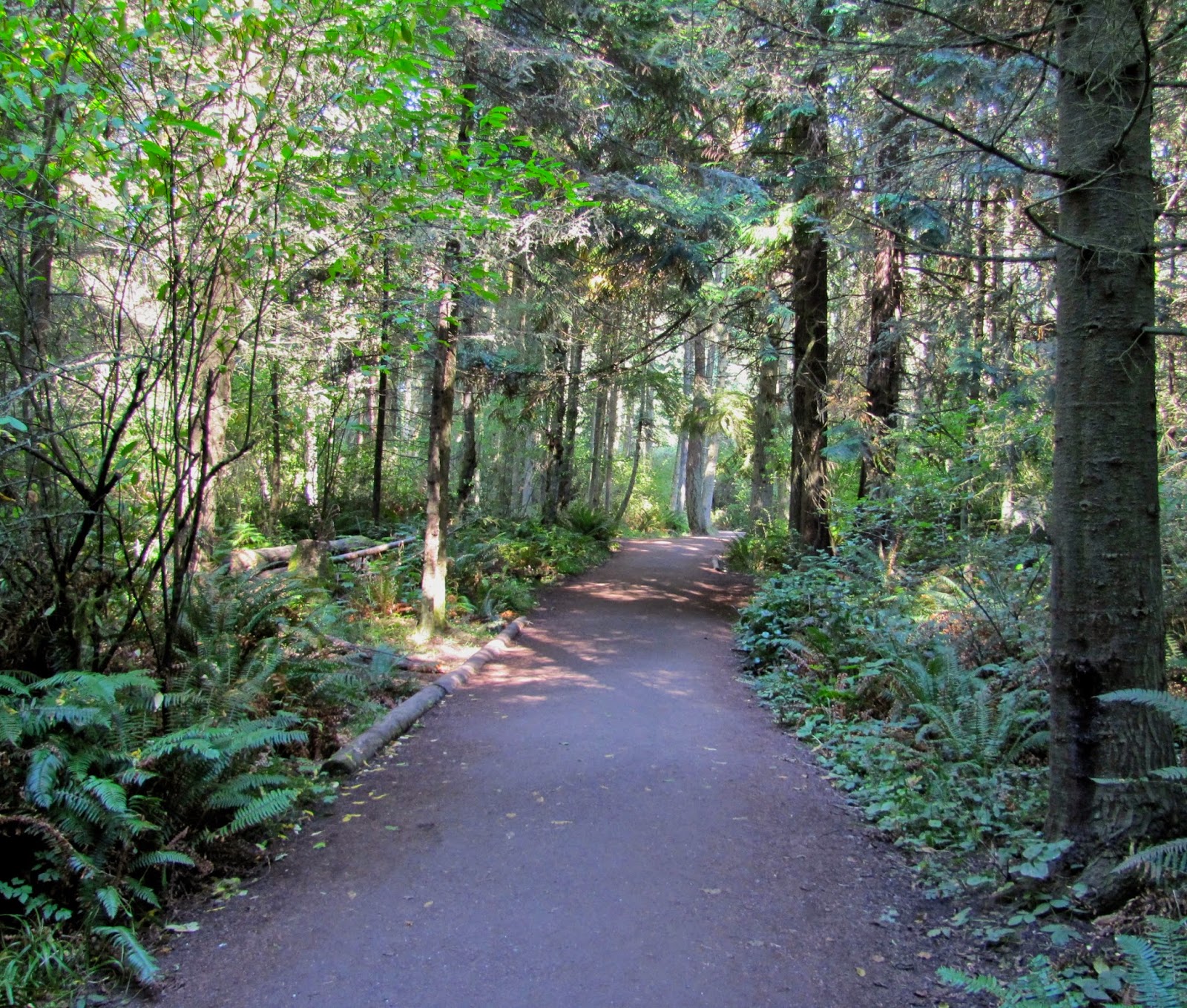
Upland forest trail heading toward "the Spit."

Today the weather was perfect for a rather long trek, but I didn't tromp all the way out to the lighthouse. That is a 10-mile round trip and I don't think I've trained enough yet.

The walk starts in the forest, and pleasantly meanders gradually downhill until that last 1/8th mile when it is somewhat steep, but on a wide, smooth trail.

Then the trail opens up and suddenly you can see the upper end of Puget Sound, the Strait of Juan de Fuca and across to the island of Vancouver, B.C.
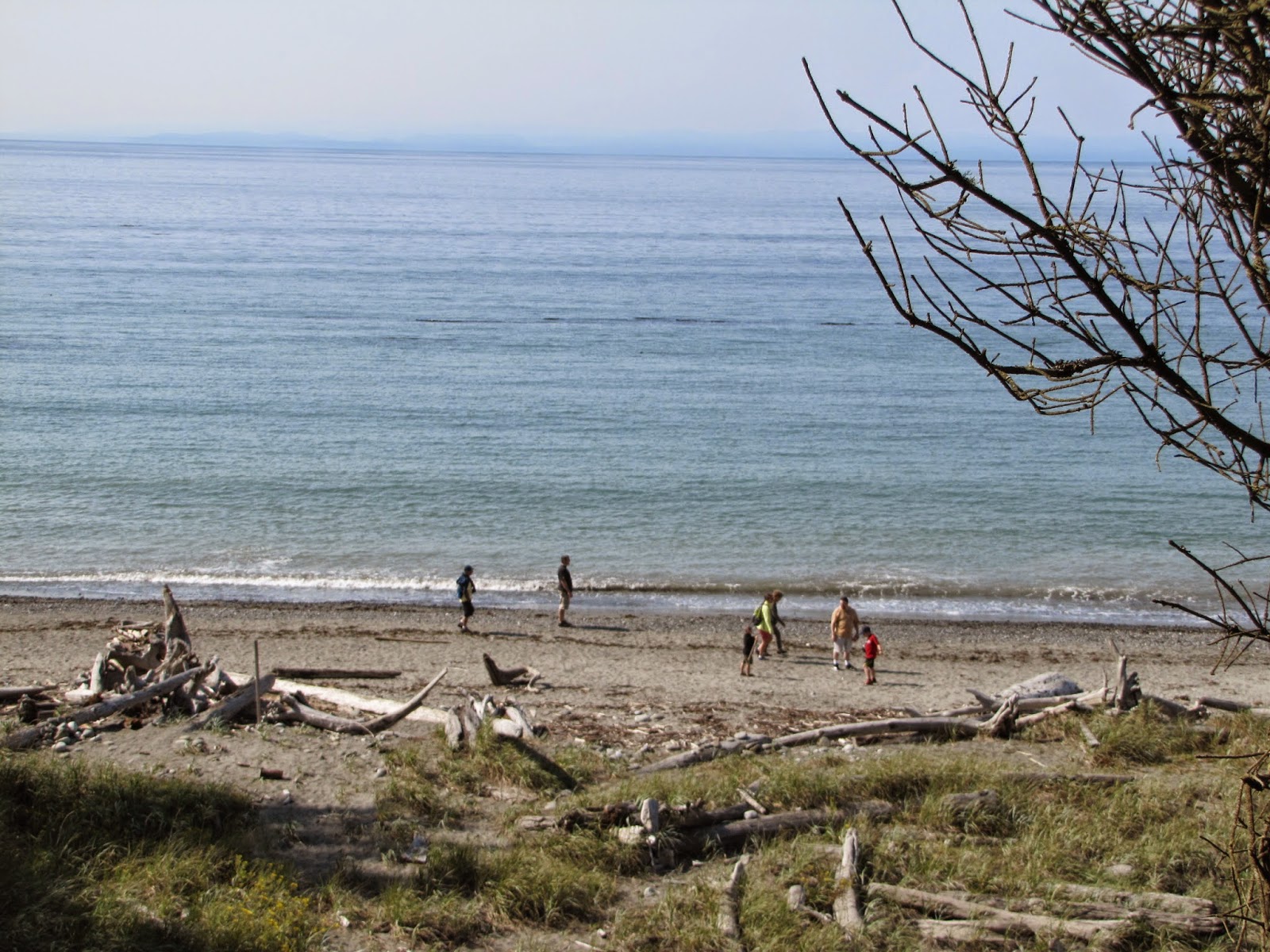
The waves from the Strait of Juan de Fuca create the Spit,
and the bluffs nearby are gradually eroded.
On this gorgeous day, there were plenty of people sunning themselves and even a few were swimming in the water. One woman was walking the beach water line looking for stones in the shape of a heart. She said she collects them. This, in spite of the admonition on one of the signs that the taking of wood, stones or other items from the area is forbidden.
People do a lot of rearranging of the stones on the beach.

Judging from the number of stones in varying stages of being grinded away by the salt water action, I cannot think that there is a great risk of them disappearing because folks are collecting them.

Do you suppose there is someone who has catalogued them and is keeping track of where they all are? A fine government job!
Well, it looked like a heart for a bit...
it's the white one.

When I visited the Pacific coast, up at  Rialto  Beach, I noticed the stones there are being shaped much rounder. Here they are being washed flatter. Even so, I found myself walking and looking down and here is what I found:

A ship loaded with freight heads out to the Pacific Ocean.
Naturally I left it there. I imagined getting back to the Ranger kiosk and having them force me to empty my pockets and then suddenly a large crowd would gather and I would be further humiliated by getting caught... wondering now what the Federal Register lays out as the punishment for removing rocks. No wonder the indigenous peoples are in wonderment about all our rules.

All kinds of creatures, feathered, finny and furry, take advantage of this refuge.

During the spring the seals use the protected harbor beach at the end of the Spit for their pups. In the fall and the spring, the migrating birds take a break from their journey and other native birds are here all year.

This is the sea grass that is essential for nesting birds.
I didn't see one bird on the ground anywhere today. Perhaps they took a holiday. Of course there were seagulls.
The hotter-than-average summer has made the waters in the
Strait less than frigid. 
On my way back up the path I found myself passing a couple who were dragging their feet. Noting they were considerably younger than me, I asked them if they'd had a nice day, curious to learn why they seemed so tired. "We've just completed the walk out to the lighthouse and back," the guy told me. "It seemed shorter heading out than it was coming back," his female companion added.

The Olympic range is off in the distance. The eroding bluff
is to the left in the photo.

I feel so fortunate that I live in such a beautiful area. And that this portion of accessible loveliness is pretty close to my home.

When my son was out visiting we walked along the bluffs. There has been so much erosion, portions of the path I walked a year ago have disappeared and the Rangers have re-routed it.

I have no idea at what speed it will progress, or what will happen to the park itself if the bluffs simply disappear. At least the scientists can't blame the erosion on global warming. Or can they?
Waves on the shore; small now, but come back when the
fall winds whip them up and see them then.

Sunday, June 8, 2014

Conservation Tour

Where I now live used to be farmland, much more than presently exists. A group called North Olympic Land Trust has, since 1990, been trying to conserve large parcels of this land for future use.
A view from one of the farms that has been saved from
commercial development; over 60 acres for grazing or growing.

Today I joined a small group of bicyclists to have a tour of the lands which have been put into conservation easements and while it was a long ride (over 15 miles!!), it was a lovely day and I had a chance to see parts of the peninsula I might have otherwise missed.

While certain realtors and developers might not like this saving of lands with prime views and such, it is important to save these farms for future use.

As land is sold and developed, it is removed from the resource of access for grazing or growing, thus making it necessary to have the farms farther and farther away from the people who really do need them, in spite of those who think that milk comes from a carton and meat comes packaged in the store.

Siebert's Creek runs clear thanks to protections by a non-
profit land conservation organization.
One land owner is a breeder of draft horses, and he bought
it knowing about the conservation easement. His use keeps
the land in agricultural production, but still protects it for the
future, and other agricultural uses.
Some years ago my family gave up land to a national trust for management and care and, in the long run, it is a better decision than letting it get sold for some developer's gain. The pond and land around it still supports the wildlife and is a place of enjoyment for fishermen, canoe paddlers and swimmers in the summer.

I have seen what happens to places where little concern is given to protection of the land and where the rich come in and buy up places for their own use. Small villages or towns, once appreciated for their unique and special qualities, soon are overwhelmed by new landowners of carefully manicured acres of lawns, and the chemicals used to keep the 'estates' maintained run off into streams and rivers.

There is so much more to the issue of land use that I cannot go into it all here, but it is encouraging that some folks are beginning to see that none of us really 'own' the land, but are merely users living on it.

Spending the day on a bicycle, seeing how some of the owners have chosen to protect the land for the future, gives me hope.